

Meet the Animals
Meet the animal species being studied by Roots2Reef. These incredible species can be found in the waters surrounding the Turks and Caicos Islands and are key to the health and well-being of the islands and the marine environment. Scroll down to learn more about the species we study and why.

Southern stingray

Oceanic whitetip shark spotted during field work (Brilliant Studios)

Whitespotted eagle ray

Mutton Snapper before release

Bonefish caught and released on fly

Gray or mangrove snapper
Southern stingray
Hypanus americanus

Southern stingrays are a common elasmobranch species found throughout the Turks and Caicos Islands, typically over sandy bottoms and seagrass beds where they search of food. These rays specialize in hunting buried prey such as crabs, shrimp, molluscs, and small fish, using a keen sense of smell as well as highly sensitive electroreceptors (called ampullae of Lorenzini) to detect movement beneath the sand. Once prey is located, they skillfully flap their large pectoral fins to uncover and capture it. Southern stingrays are easily recognized by their flat, round body and long, whip-like tail, which carries one or two large serrated venomous spines used for defence. Tpically, these rays occupy small homeranges and we do not expect to see major predictable migratory movements. However, irregular largescale movements can and do happen and are important drivers of genetic diversity within the population.
Whitespotted eagle ray
Aetobatus narinari

Whitespotted eagle rays are striking rays found in tropical and warm-temperate waters around the world, known for their graceful swimming and distinctive spotted pattern, similar to the spots on a leopard. Each individual has a unique pattern of white spots across its dark back, much like a fingerprint, allowing rays to be identified if they are sighted again by researchers or members of the public. Currently, whitespotted eagle rays are listed as "endangered" on the IUCN Red List, highlighting the importance of monitoring and protecting this vulnerable species. These rays play an important ecological role as large meso-predators and are highly valued within the tourism industry amongst snorkelers and divers alike. They are highly mobile and have been known to migrate large distances seasonally. Better understanding their movements in the Turks and Caicos Islands, including their space use within and connectivity between protected and unprotected areas will allow us to better inform their conservation and management.
Mutton snapper
Lutjanus analis

Mutton snapper are commonly found in close proximity to structured habitats such as coral reefs, rocky areas, and mangroves, where they spend much of their time moving between feeding and shelter sites. Juveniles in particular rely on shallow mangroves and seagrass beds for protection and nursery habitat before gradually shifting to deeper reef environments as they grow. They are recognizable by their olive-coloured backs with a reddish tinge on the underside, a distinct black spot on the upper back, and bright blue stripes across the face. Individuals typically reach sexual maturity at a total length of 40–50 cm and an age of 3–5 years, with females maturing slightly later than males. The mutton snapper is listed as "near threatened" on the IUCN Red List, largely due to fishing pressure, especially at spawning aggregation sites. This species is highly resident within its home range, yet undertakes monthly spawning migrations of up to 70 km over the full moon to visit spawning sites from February through August. Our research aims to better understand the catchment size for individual spawning aggregation sites for this species in the TCI.
Gray snapper
Lutjanus griseus

Gray snapper, also known as mangrove snapper, are a highly adaptable species found in both coastal and offshore habitats, including coral reefs, rocky ledges, mangroves, and seagrass beds, and have even been recorded in freshwater lakes due to their strong tolerance for variable salinities. They are generally gray in colour with darker dorsal and tail fins, sometimes showing faint orange spots arranged in subtle vertical rows. As opportunistic carnivores, gray snapper feed on fish, crustaceans, and other small prey, and during the warmer months from April to November they form offshore spawning aggregations, often peaking around the full moon. These fish are popular eating fish, which has applied pressure on their populations. Our research aims to monitor this species and identifying sensitive habitats key to their sustainability and management.
Bonefish
Albula vulpes
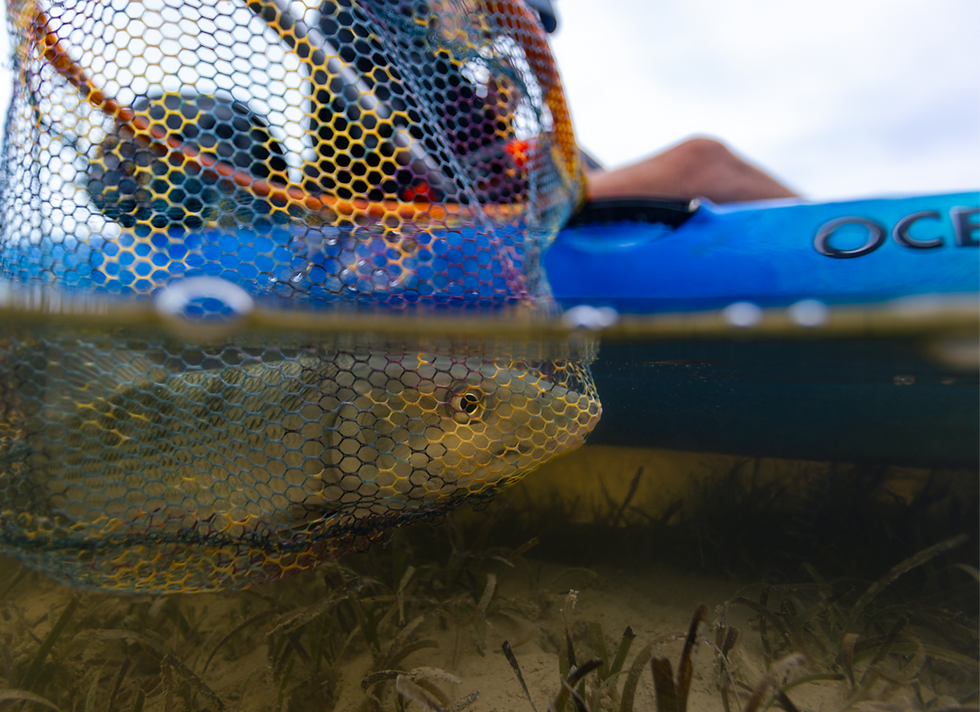
Bonefish are iconic saltwater game fish that occupy the sandy flats and shallow waterways of tropical coastal waters. Their name comes from the many fine bones in their bodies, which makes them less desirable to eat. Bonefish are uniquely adapted to life in shallow environments, possessing a lung-like swim bladder that helps them absorb oxygen and survive in low-oxygen habitats. They feed primarily on small fish, decapods, crustaceans, and gastropods, using strong crushing teeth to break apart hard-shelled prey. Their raw power and preference for shallow waters, where they can be 'sight-fished', has led to the development of a strong catch-and-release fishing culture centered around the species. Anglers travel from around the world to pursue these powerful and fast-moving fish, making them an important species for fishing tourism. However, improper handling of fish during catch-and-release can leave bonefish stressed and vulnerable to predators. Bonefish are highly resident to small home ranges yet move during pre-spawning and spawning aggregations. Better understanding this behaviour can help to inform their effective conservation and management.
Oceanic whitetip shark
Carcharhinus longimanus

Oceanic whitetip sharks are large-bodied, pelagic sharks that inhabit the upper layers of deep offshore waters, where they move slowly and often hunt alone as opportunistic predators. They are easily recognized by the distinctive mottled white markings on the tips of their dorsal, pectoral, and tail fins, which give the species its name. Their large paddle-shaped fins are highly valued in the shark fin trade, while their meat is consumed and their skin is used for leather, driving significant fishing pressure. They are also commonly caught and killed as bycatch within industrialised pelagic fisheries. Often living for 20–36 years and reaching sexual maturity between 6 and 9 years of age, these sharks have a slow life cycle that makes them particularly vulnerable. The species is classified as "critically endangered" by the IUCN, with populations continuing to decline, highlighting the urgent need for their protection and sustainable management.